

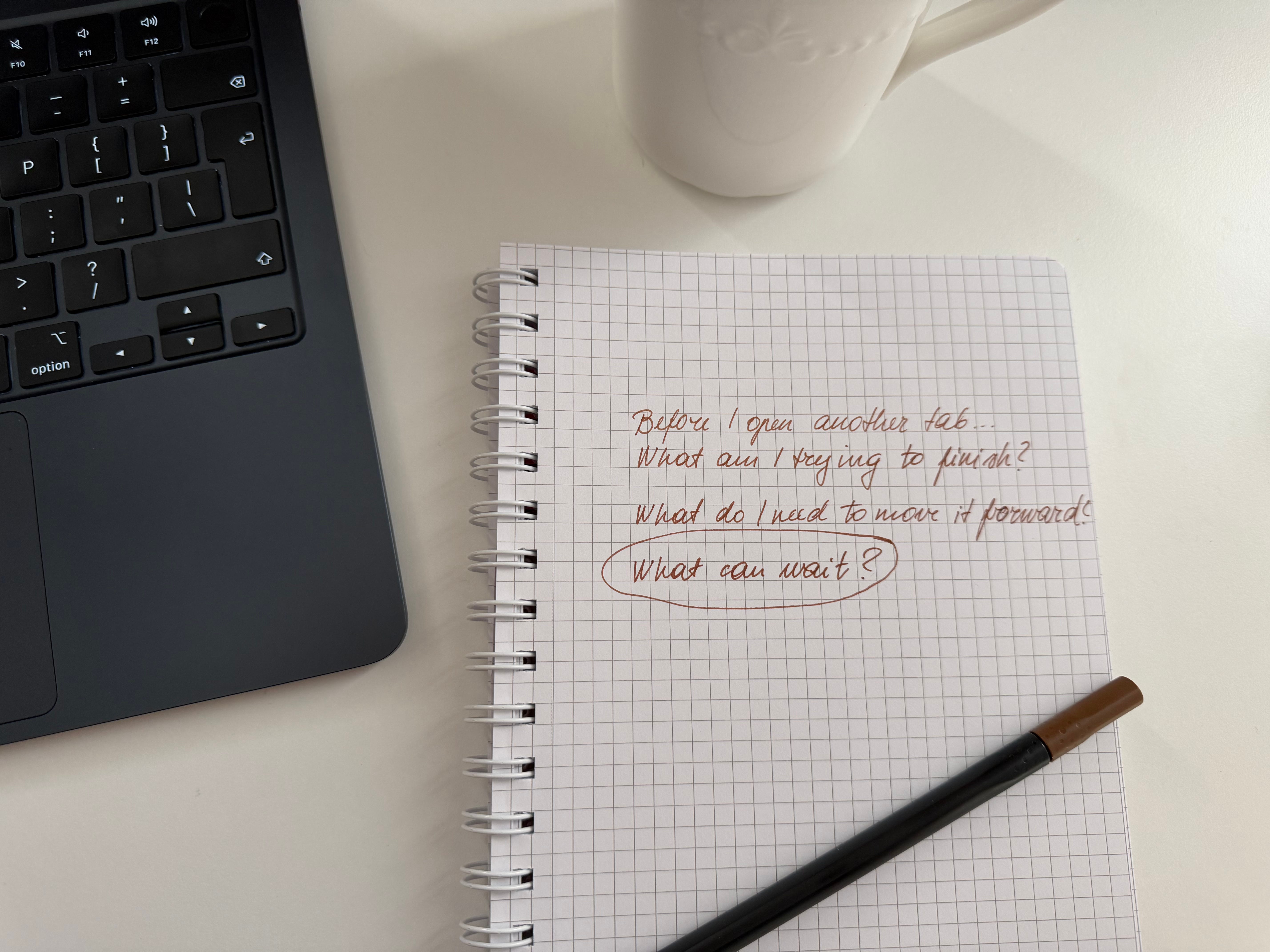
There’s a particular kind of chaos in having your work spread across so many places. The task is in one app. The conversation that explains it is somewhere else. The draft you want to return to is sitting in an AI chat, although you can’t quite remember which one.
Before you can do the work, you have to piece it back together.
And now AI is here to help. It can help you think, organise, write, and get past a blank page. But it also asks something of you. Choose a tool. Explain the context. Check the answer. Decide where to save it.
A tool can make one task faster while making the day harder to follow.
That’s the part I want to explore: how do we keep our focus when even the help needs managing?
Three books offer useful starting points: The Design of Everyday Things, Diffusion of Innovations, and Power and Prediction. Their ideas about design, adopting new things, and changing how work happens reach surprisingly well into an ordinary workday.
These are ten practical ways I’d apply them.
Notice where you keep losing the thread.
In The Design of Everyday Things, Don Norman draws attention to how design can make everyday activities easier or unnecessarily difficult. Good design can fit our needs so well that we barely notice it.
Apply that to your work. Where do you repeatedly stop? Finding the latest document? Remembering what someone decided? Figuring out which task comes next?
Pick one recurring interruption to fix. “Put the approved version here” gives you something more concrete to change than “be more focused.”
Give yourself one place to return to.
You may need several tools. A client uses one, your team uses another, and your files live somewhere else.
Create one small starting point for each active project: the current document, the latest decision, and the next action. Link to the originals so you don’t create another set of copies to maintain.
This can be an ordinary note. The useful part is knowing where to begin when you come back.
Leave a note for the person returning tomorrow.
Before you close a task, write down where you stopped.
“Finish proposal” leaves plenty to work out. “Check the price in the latest email, update page two, then send for review” gives you a way back in.
Include the relevant link. If you’re waiting for someone, write that down too.
You shouldn’t have to reread an entire conversation to remember the next five minutes of work.
Look at what happens around the AI.
In Power and Prediction, Ajay Agrawal, Joshua Gans, and Avi Goldfarb explain why AI’s value can be limited when the surrounding system stays unchanged. The same capability can become more useful when the work around it changes.
Here’s a small application: if AI produces meeting notes, what happens next?
Someone still needs to check the decisions, confirm who owns each action, and put those actions where the team will see them. Agree on that path. Otherwise, you may have added a beautifully written document to the pile.
Try one small thing before changing everything.
Everett M. Rogers describes trialability in Diffusion of Innovations: being able to experiment with an innovation on a limited basis helps reduce uncertainty about adopting it. Try applying it to one recurring task. Use AI to prepare a first draft of your weekly update for a few weeks.
Notice what gets easier, what needs correcting, and whether you want to use it again. A small experiment gives you something real to judge.
Choose something that fits your actual day.
Rogers also identifies compatibility with people’s needs and experience, along with perceived complexity, as factors in adoption. That matters alongside a tool’s apparent advantages.
For everyday work, consider how much remembering the new setup requires. Will you need to move information into it every morning? Will your team check another place?
Include those demands in your choice. A tool’s place in your day deserves as much thought as its features.
Keep the context you repeatedly explain.
If you keep giving AI the same background, save a short, reusable brief.
Include what the project is for, who it’s for, the important constraints, and what has already been decided. Keep it beside the project and update it when something changes.
You can still ask a different question each time. You’ll have a starting point for the parts that stay the same, without rebuilding the whole explanation from memory.
Ask for an answer you have room to use.
AI makes it easy to ask for more. More ideas, more versions, more possibilities.
Sometimes you need that exploration. Sometimes you need to finish an email.
Match the request to the moment: “Give me two options under 100 words, and explain the main difference.” Or: “Identify the one missing detail I need before I can finish this.”
Decide what you need from the answer before generating another page of things to consider.
Count the checking, choosing, and moving.
When you judge whether AI helped, look at the whole task.
Include the time spent finding the source material, explaining the request, checking the result, editing it, and putting it where it belongs.
You don’t need a complicated tracker. Ask whether you finished sooner, whether the result was useful, and how much attention it took.
A quick first draft can be valuable. You’ll understand its value better once you’ve followed it through to finished work.
Give curiosity its own time.
Learning about a new tool and finishing today’s work both deserve space.
When something interesting appears in the middle of a task, save a link and a sentence about what you might use it for. Return to it during a time you’ve set aside to explore.
A new possibility doesn’t have to become an immediate assignment. You can be interested in it and continue with what you were doing.
You don’t need to turn all ten ideas into another list of obligations.
Start with the place where you keep losing your thread. Make the latest version easier to find. Leave a clearer next step. Try one AI task all the way through and see whether it helps.
There will still be messages, unfinished work, and new things to learn. But perhaps you’ll be able to sit down, find what you need, and continue.
That would already make a difference.
What do you keep having to find, remember, or explain again before you can get on with your work?